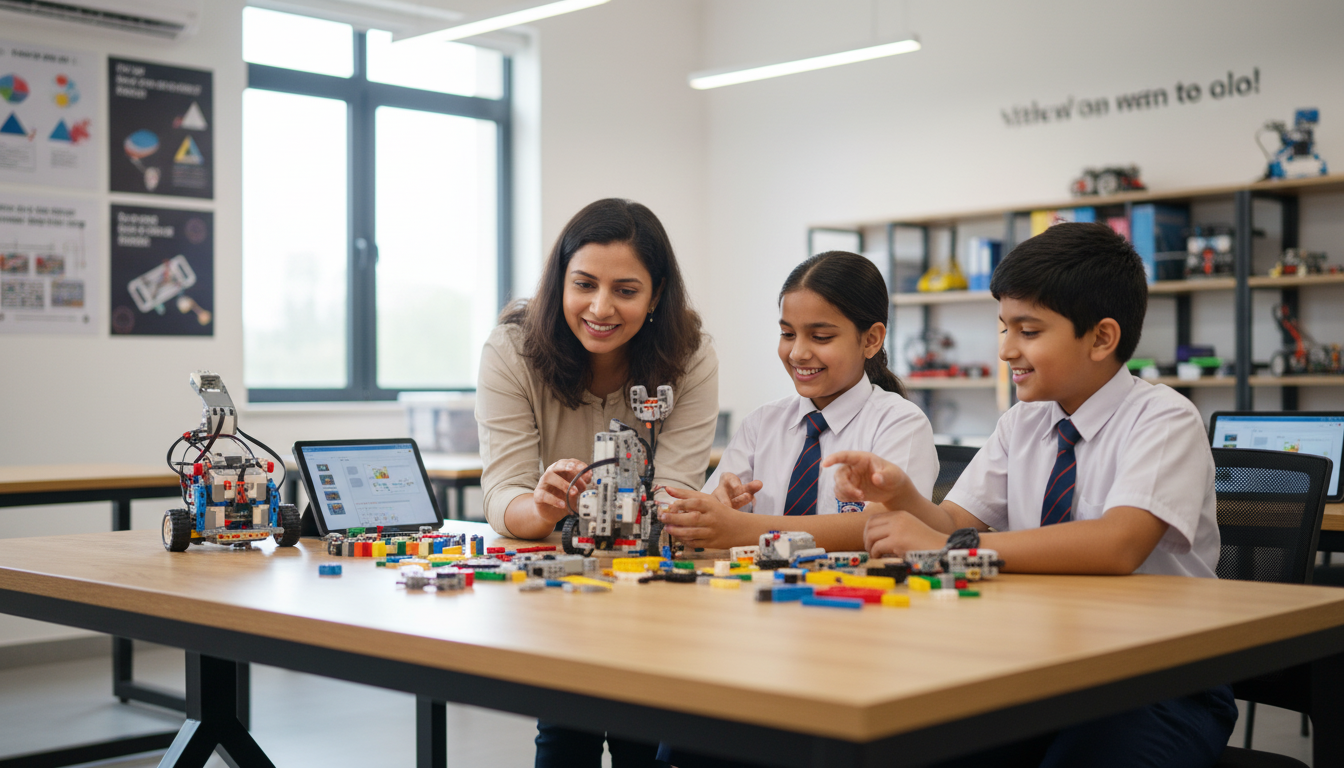
Two policy changes are quietly reshaping how CBSE schools teach. Kaushal Bodh, NCERT’s project-based Skill Education for the middle stage, is now mandatory, and the CBSE Composite Skill Lab must be in place in every affiliated school by 22 August 2027. Both put NEP 2020 and NCF-SE 2023 into practice, shifting the classroom from rote learning to hands-on, competency-based projects.
For school leaders, the question is no longer whether to act, but how to do it well. This guide explains what the two mandates require, why hands-on learning is the deciding factor, and how the new LEGO® Education kits, delivered by RoboGenius, help schools comply while genuinely raising the quality of learning.
What the CBSE skill mandates actually require
CBSE’s move to skill education is not a single rule but two connected requirements, one about what is taught and one about where it is taught.
Kaushal Bodh: skill education for Classes 6 to 8
Kaushal Bodh (literally “skill wisdom”) is a set of NCERT-developed, project-based activity books for Classes 6, 7 and 8. From the 2025-26 session, CBSE has made it a mandatory, assessed subject for every affiliated school. In practice, it means:
- About 110 hours a year, roughly five periods a week.
- Three projects a year, one from each of three work domains, adding up to nine projects by Class 8.
- Assessment that is roughly 80% practical and 20% theory, based on an activity book, a presentation or viva, teacher observation and a portfolio.
- A year-end Kaushal Mela, a skill fair where students showcase what they built.
The three work domains, defined by NCF-SE 2023, are Work with Life Forms, Work with Materials and Machines, and Work in Human Services. The middle one, materials and machines, is where making, basic electronics, coding and simple AI live.
The Composite Skill Lab (CBSE Circular Skill-75/2024)
Issued on 23 August 2024, CBSE Circular Skill-75/2024 requires every affiliated school to set up a multidisciplinary Composite Skill Lab for Classes VI to XII. The essentials:
- One 600 sq ft lab, or two 400 sq ft labs (one for VI-X, one for XI-XII).
- Compliance for existing schools by 22 August 2027.
- A fully equipped lab is now a prerequisite for fresh CBSE affiliation.
- The lab should span domains such as AI and Machine Learning, Robotics and Automation, Coding and App Development, IoT and Electronics, 3D Printing, Drones, Design Thinking and Data Science.
Mandate details follow official CBSE and NCERT guidance. Because specifics can change year to year, schools should always confirm against the latest CBSE circulars at cbseacademic.nic.in.
Why hands-on, project-based learning is the deciding factor
Both mandates reward the same thing: learning you can see. Kaushal Bodh is graded on what students build and how they present it. A Composite Skill Lab is judged not just on equipment, but on whether it is genuinely used. That makes the choice of tools and teacher support far more important than a checklist of hardware.
Where the new LEGO® Education kits fit
LEGO® Education is launching two new hands-on solutions for Grades K-8, and as the Official LEGO® Education Reseller in India, RoboGenius is among the first to bring both to Indian schools.
LEGO® Education Computer Science & AI Kit
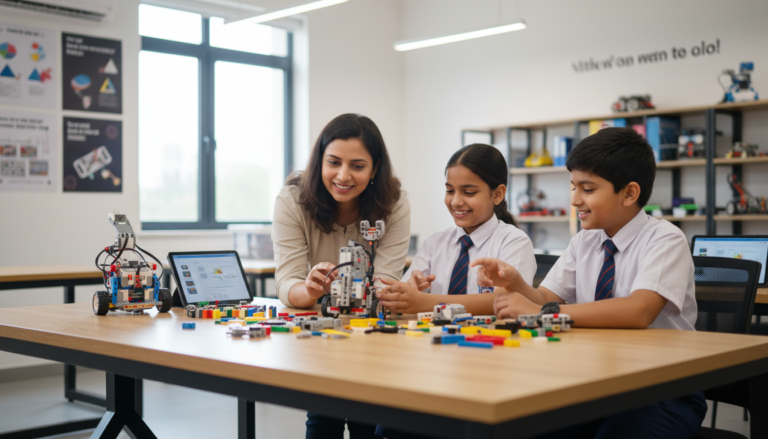
This K-8 kit moves students from simply using AI to understanding how it works. Working in groups of four, students use familiar LEGO® bricks, block-based coding and camera-based AI to build and train simple AI models. It develops genuine AI literacy, computer vision, classification and probabilistic thinking, and it is safe and private by design: no student logins, with all work staying on the device.
LEGO® Education Science Kit
The Science Kit is a fully screen-free, hands-on way to learn science. Students build, test and observe real physical models, reaching genuine “aha” moments through inquiry. With no student devices required, it supports the experiential, project-based science that NEP 2020 encourages across the middle stage.
Mapping the kits to Kaushal Bodh and the Composite Skill Lab
Used honestly, the kits map to specific parts of each mandate, not all of them.
- Kaushal Bodh, Form 2 (Materials and Machines): The Computer Science & AI Kit gives ready, structured projects for making, coding and simple AI, the same territory as a “simple AI assistant” in Class 7 or home-automation logic in Class 8.
- Optional AI and coding modules: The kit is a hands-on way to deliver the AI and coding skill modules a school can fold into its Kaushal Bodh hours.
- Composite Skill Lab domains: The Computer Science & AI Kit supports the AI and Machine Learning, Robotics and Automation, and Coding and App Development domains; the Science Kit strengthens the lab’s hands-on science and design-thinking foundation.
- Assessment and showcase: Every kit activity is a build-test-present project, producing the portfolio evidence and Kaushal Mela outcomes the assessment model rewards.
Tools are suggested only where they naturally fit a work domain; schools remain free to choose or design projects around their own context.
How RoboGenius helps CBSE schools
Compliance is only useful if the lab is active. RoboGenius delivers every solution as a turnkey programme, backed by nearly two decades of experience and 3,500+ schools served:
- Genuine LEGO® Education kits, with warranty, spare parts and curriculum backing.
- Teacher training that builds in-house capability, supporting CBSE’s capacity-building expectations.
- Structured, NEP 2020-aligned curriculum and project manuals.
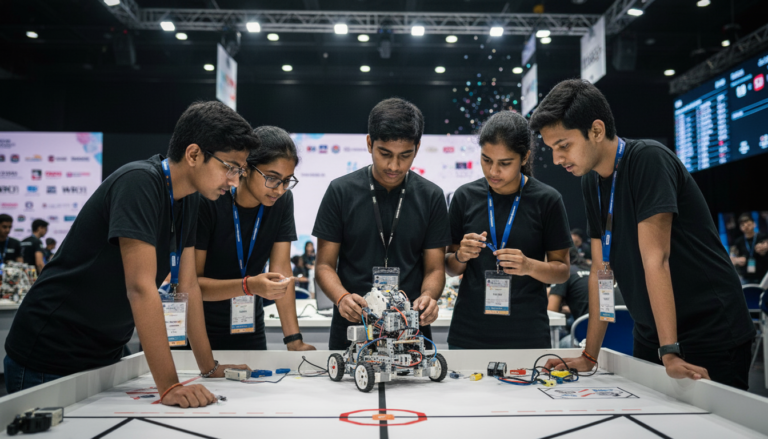
- Competition pathways, including WRO and CBSE science exhibitions.
- 365-day, year-round technical support.
Getting 2027-ready, the simple way
The 2027 deadline sounds distant, but planning space, budget, curriculum and teacher training takes time. Starting with a single grade or a pilot workshop lets your school see results before scaling.
Ready to make your school 2027-ready?
Talk to the RoboGenius team for a walkthrough of how the LEGO® Education kits map to Kaushal Bodh and your Composite Skill Lab plans.
FAQs About CBSE Composite Skill Lab and Kaushal Bodh
What is a CBSE Composite Skill Lab?
A Composite Skill Lab is a single, multidisciplinary space where students in Classes VI to XII learn by doing, building models, coding devices, exploring robotics and AI, and prototyping ideas across skills like AI, robotics, coding, IoT, electronics and design thinking.
Is a Composite Skill Lab mandatory for CBSE schools?
Yes. Under CBSE Circular Skill-75/2024, every affiliated school must set up a Composite Skill Lab, and a fully equipped lab is a mandatory prerequisite for fresh CBSE affiliation.
What is the deadline to set up the Composite Skill Lab?
Existing CBSE-affiliated schools must comply within three years of the 23 August 2024 circular, that is, by 22 August 2027.
What are the space requirements for a Composite Skill Lab?
Schools can set up one lab of 600 sq ft for Classes VI to XII, or two separate 400 sq ft labs, one for Classes VI to X and one for Classes XI to XII.
Is Kaushal Bodh mandatory, and from when?
Yes. CBSE has made Kaushal Bodh mandatory for all affiliated schools, both private and government, for Classes 6 to 8, from the 2025-26 academic session.
What is Kaushal Bodh?
Kaushal Bodh is NCERT’s series of project-based Skill Education activity books for Classes 6, 7 and 8. It puts NEP 2020 and NCF-SE 2023 into practice through hands-on projects rather than rote learning.
How much time does Kaushal Bodh take?
About 110 hours across the academic year, roughly five periods a week, with three projects a year and nine completed projects by the end of Class 8.
How is Kaushal Bodh assessed?
Through continuous, project-based assessment, roughly 80% practical and 20% theory. Marks come from activity-book completion, a presentation or viva, teacher observation, a portfolio and a short written check, and they feed into internal assessment. The year closes with a Kaushal Mela.