
Introduction to Arduino Learning Programs
Ask any senior-school STEM teacher what single tool has done the most to get kids building real, working electronics — and most of them will say Arduino. It’s small, cheap, friendly to beginners, and powerful enough that engineering undergrads still use it in their final-year projects.
For Indian schools thinking seriously about their senior-school STEM strategy, Arduino learning programs sit in a sweet spot: affordable, deeply hands-on, aligned to NEP 2020, and a perfect bridge between block-based coding and real-world engineering. This guide walks school leaders and teachers through what a strong Arduino learning program looks like — from the very first LED blink to full-blown IoT projects.
Why Arduino Learning Programs Work So Well for Students
Arduino hits the rare trio of being cheap, simple to start with, and virtually unlimited in what you can build with it. A single Arduino Uno can drive a traffic light simulation, a smart irrigation system, a weather station, or a mini robot — all with the same board.
That flexibility is exactly why Arduino learning programs have become a staple in schools across India. Students don’t just learn syntax; they learn to think like engineers.
Arduino as a natural progression from block coding
Most students in good schools already get exposure to Scratch and block-based coding by grade 5 or 6. But by grade 8 or 9, block coding starts to feel limited. Arduino learning programs step in at exactly the right moment — introducing real C/C++ syntax, real hardware, and real debugging skills without the cliff of jumping straight into professional embedded systems.
What a Good Arduino Learning Program Looks Like?
A strong school-level Arduino learning program is built in three clear phases. Skipping any of them is the most common reason schools end up with shelves full of unused Arduino kits.
Phase 1: Foundations of Arduino Learning Programs (Grades 7–8)
Start here. Students learn what a microcontroller is, how to wire an LED to a breadboard, how to read analog and digital pins, and how to write their first few lines of Arduino C. This phase should cover basic input/output, buttons, LEDs, servo motors, simple sensors like LDR and temperature sensors, and the core of the `setup()` and `loop()` functions.
By the end of this phase, students should be able to build a working traffic light, a reaction-timer game, and a motion-activated LED.
Phase 2: Intermediate Projects and Logic (Grades 8–9)
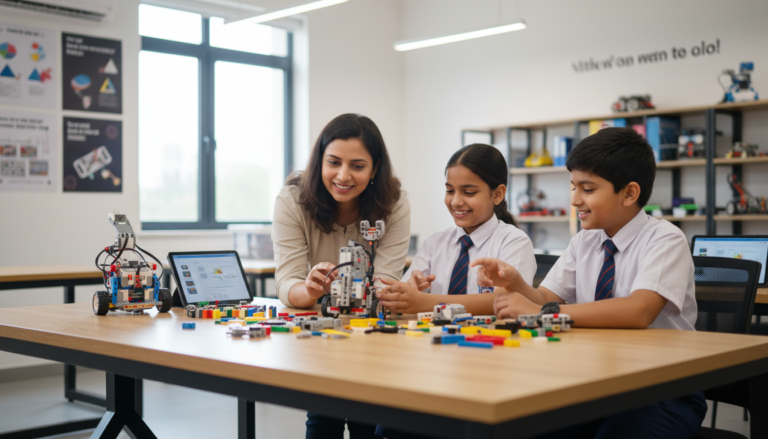
This is where things get fun. Students start combining sensors and actuators, reading from serial monitors, driving motors, and building small autonomous systems. Projects get more ambitious- obstacle-avoiding mini-robots, automatic plant-watering systems, smart doorbells with gesture recognition, and simple security systems.
Arduino learning programs at this level also introduce proper debugging habits, code comments, and wiring diagrams- skills that matter more in competitive robotics and science fairs than students initially realize.
Phase 3: IoT and Advanced Arduino Projects (Grades 9–12)
This is where Arduino learning programs shift from “fun with electronics” to “building solutions that matter.” Using Arduino-compatible boards like ESP32 and NodeMCU, students connect their projects to the internet and move into IoT territory.
Building Real-World IoT Projects With Arduino
IoT is no longer a buzzword. It’s one of the most demanded skill sets in Indian tech- and Arduino is the most student-friendly entry point.
Smart home projects
Students can build app-controlled lights, temperature-triggered fans, voice-activated locks, and Bluetooth-controlled appliances — all using Arduino, a relay module, and an ESP8266 or ESP32.
Agricultural IoT projects
India’s agri-tech sector is exploding, and school projects are an incredible way for students to understand the impact side of engineering. Smart irrigation systems, soil moisture monitors, and weather-aware greenhouse systems are all buildable with a basic Arduino IoT kit.
Health and safety projects
From pulse-rate monitors to fall-detection wearables for the elderly, Arduino’s wide range of sensors lets students tackle real, socially meaningful problems — perfect for science fairs and innovation competitions.
Environmental monitoring
Air quality sensors, noise-level monitors, and real-time dashboards are some of the most impressive student IoT projects you’ll find at school expos across India.
Integrating Arduino Learning Programs Into the School Curriculum
Arduino isn’t an after-school hobby anymore. The best schools now run Arduino learning programs as a structured part of the senior-school STEM curriculum- mapped across computer science, physics, and robotics periods.
Grade-by-grade integration
Introduce Arduino by grade 7, move into intermediate projects by grade 8, and target IoT projects from grade 9 onwards. By grade 11, motivated students should be able to propose and build independent Arduino-powered capstone projects.
Tie it into competitions
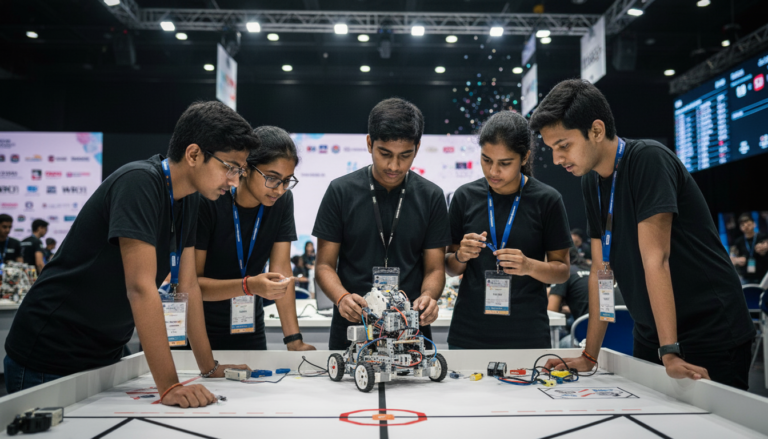
Arduino-powered projects dominate categories at the Atal Tinkering Marathon, IRIS National Fair, CBSE science exhibitions, World Robot Olympiad (WRO India) and countless state-level innovation contests. Schools that run structured Arduino learning programs consistently produce more award-winning projects.
Teacher Training Is Non-Negotiable
Arduino is famously beginner-friendly, but teaching it well is a different skill. A strong Arduino learning program includes certified teacher training covering electronics basics, Arduino C, safe breadboarding practices, and troubleshooting — because nothing kills momentum faster than a teacher who can’t debug a miswired circuit in front of 30 curious students.
Ready to Launch Arduino Learning Programs at Your School?
If you’re planning to introduce Arduino learning programs — or take an existing one from basics to full IoT projects — talk to RoboGenius. We’ll help you design a grade-by-grade curriculum, source the right Arduino and IoT kits, and train your STEM teachers so the whole programme actually delivers.
FAQs About Arduino Learning Programs
What age is best to start Arduino learning?
Most Indian schools start Arduino learning programs around grades 7–8, after students have some comfort with block-based coding. With strong teacher support, even grade 6 students can handle basic Arduino projects.
Is Arduino good for beginners in coding?
Yes. Arduino was specifically designed as a beginner-friendly entry point into electronics and embedded programming, and its huge online community means troubleshooting is easy.
What are the best Arduino projects for students?
Popular student projects include LED traffic lights, smart dustbins, obstacle-avoiding robots, automatic plant-watering systems, weather stations, and IoT home automation systems.
What is the difference between Arduino and Raspberry Pi?
Arduino is a microcontroller built for real-time hardware control, while Raspberry Pi is a mini-computer suited for heavier software tasks. Arduino is usually the better starting point for school students.
How long does it take to learn Arduino?
Students can build their first working Arduino project in a single class period. Becoming confident across electronics, coding, and project design typically takes 6–12 months of structured learning.
What is Arduino IoT used for?
Arduino IoT is used to connect physical devices to the internet — powering smart homes, environmental monitoring systems, smart agriculture setups, and student innovation projects.